
Recap of Part 1
In Part 1 of this series we covered the fundamentals: what Pydantic is, who created it, installation with uv, building models with BaseModel, automatic type validation, the difference between valid/invalid data, and JSON serialization/deserialization. If you haven’t read it yet, it’s worth starting there - this post assumes you already know how to build a simple model and understand what a ValidationError is.
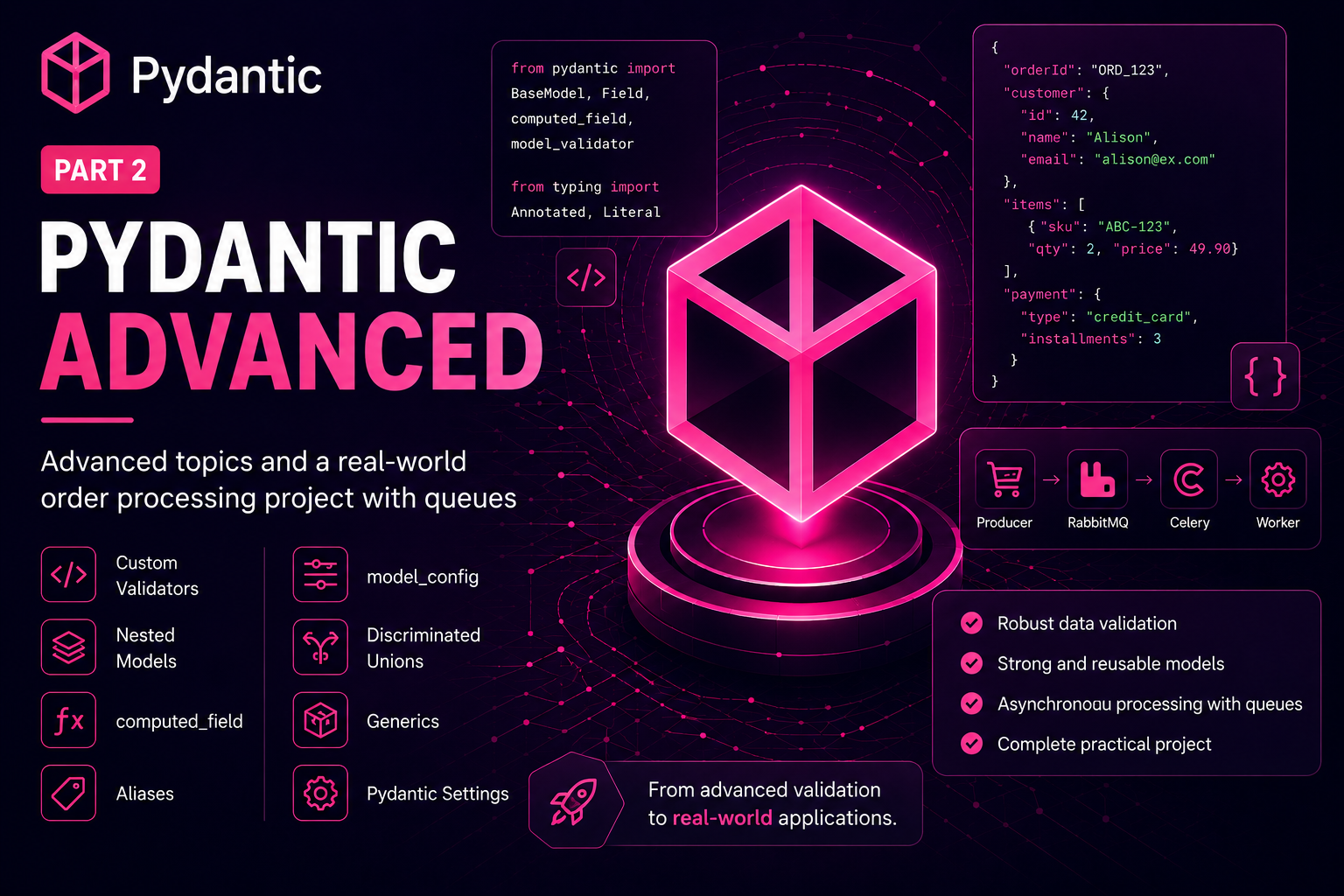
Here we’ll move on to what actually separates “basic” Pydantic usage from “professional” production usage: custom validation rules, fine-tuning model behavior, composing complex models, reusable types, and application configuration management. We’ll close with a complete practical project, simulating a real order-processing service consuming messages from a queue.
Custom validators: field_validator and model_validator
Not every business rule fits into a Field(gt=0). Sometimes you need custom logic - validating a tax ID, normalizing text, or comparing two fields against each other.
field_validator: validating (or transforming) a specific field
from pydantic import BaseModel, field_validator


class Customer(BaseModel):
    name: str
    tax_id: str

    @field_validator("tax_id")
    @classmethod
    def validate_tax_id(cls, value: str) -> str:
        digits = "".join(filter(str.isdigit, value))
        if len(digits) != 11:
            raise ValueError("tax_id must contain 11 digits")
return digits # normalize by stripping punctuationNotice that the validator doesn’t just validate - it also normalizes the data: the tax_id coming out of the model is already stripped of punctuation, regardless of how it was entered ("123.456.789-00" or "12345678900").
The mode parameter controls when the validator runs relative to the default type validation:
mode="after"(default): runs after Pydantic has already validated/converted the basic type. You receive the value already in the expected Python type.mode="before": runs before, with the “raw” value (as received, e.g. still a string or dict). Useful for pre-processing unexpected input formats before type validation.
from pydantic import BaseModel, field_validator


class Product(BaseModel):
    price: float

    @field_validator("price", mode="before")
    @classmethod
    def clean_price(cls, value):
        # accepts "$49.90" and converts it before type validation
        if isinstance(value, str):
            value = value.replace("$", "").strip()
return valuemodel_validator: cross-field validation
When a rule depends on more than one field, field_validator isn’t enough - that’s what model_validator is for, receiving the whole model (or the raw data, depending on the mode):
from datetime import date
from pydantic import BaseModel, model_validator


class Booking(BaseModel):
    check_in: date
    check_out: date

    @model_validator(mode="after")
    def validate_dates(self) -> "Booking":
        if self.check_out <= self.check_in:
            raise ValueError("check_out must be later than check_in")
return selfWith mode="after", self is already a validated model instance - you return self (possibly modified) at the end. With mode="before", you receive the raw input dict, before any field validation happens, which is useful for renaming or merging keys before standard validation kicks in.
model_config / ConfigDict: configuring model behavior
Every BaseModel can be configured with model_config, using ConfigDict:
from pydantic import BaseModel, ConfigDict


class Settings(BaseModel):
    model_config = ConfigDict(
        extra="forbid",             # rejects fields not declared on the model
        frozen=True,                # makes the instance immutable after creation
        str_strip_whitespace=True,  # strips extra whitespace from strings automatically
        populate_by_name=True,      # allows populating both by field name and by alias
    )

    environment: str
debug: bool = FalseA few options that make the biggest difference day to day:
| Option | What it does |
|---|---|
extra="forbid" | Raises an error if the payload includes unknown fields (great for catching field-name typos). Default is "ignore". |
extra="allow" | Accepts and keeps undeclared extra fields, accessible via model_extra. |
frozen=True | Makes instances immutable (like dataclass(frozen=True)) - useful for value objects. |
str_strip_whitespace=True | Automatically strips leading/trailing whitespace from every string. |
validate_assignment=True | Re-validates fields every time you do instance.field = new_value, not just on creation. |
Nested and recursive models
Pydantic models can be composed freely - a field can be another BaseModel, a list of models, or even reference its own type (recursion):
from pydantic import BaseModel


class Address(BaseModel):
    street: str
    city: str
    zip_code: str


class Customer(BaseModel):
    name: str
    address: Address                    # nested model
extra_addresses: list[Address] = [] # list of nested modelscustomer = Customer(
name="Anna",
address={"street": "Main St 123", "city": "Recife", "zip_code": "51021-000"},
)
print(customer.address.city)
#> RecifeNotice we passed a dict for address and Pydantic automatically converted it into an Address, recursively validating each nested field - including producing a detailed ValidationError with the full path down to the problematic field (e.g. address.zip_code) if something’s wrong.
Recursive models (a comment tree, for example) are also possible, using list["Comment"] with either from __future__ import annotations or quoted type hints:
from __future__ import annotations
from pydantic import BaseModel


class Comment(BaseModel):
    text: str
replies: list[Comment] = []Annotated: reusable types with built-in validation
When the same validation rule repeats across several models (say, “valid tax ID” or “non-empty string”), it’s worth extracting it into a reusable type with Annotated:
from typing import Annotated
from pydantic import AfterValidator, BaseModel


def validate_tax_id(value: str) -> str:
    digits = "".join(filter(str.isdigit, value))
    if len(digits) != 11:
        raise ValueError("tax_id must contain 11 digits")
    return digits


TaxID = Annotated[str, AfterValidator(validate_tax_id)]


class Customer(BaseModel):
    name: str
    tax_id: TaxID


class Employee(BaseModel):
    name: str
tax_id: TaxID # same validation, reused, without repeating @field_validatorThis is the “modern” approach (and the one recommended by the official docs) to sharing validation logic across different models, instead of copying the same field_validator into every class.
computed_field: derived fields that show up in serialization
Sometimes you want to expose a value calculated from other fields, but have it also appear in model_dump()/model_dump_json() - that’s what @computed_field is for:
from pydantic import BaseModel, computed_field


class OrderItem(BaseModel):
    unit_price: float
    quantity: int

    @computed_field
    @property
    def subtotal(self) -> float:
return round(self.unit_price * self.quantity, 2)item = OrderItem(unit_price=49.9, quantity=3)
print(item.model_dump())
#> {'unit_price': 49.9, 'quantity': 3, 'subtotal': 149.7}Unlike a regular @property (which doesn’t show up in model_dump()), computed_field is treated as part of the model’s output “contract” - useful for exposing totals, ages calculated from a birth date, or formatted fields without duplicating data in the database.
Discriminated unions: validating “one of several shapes”
A common problem: a payload can represent different shapes of the same concept - for example, a payment can be by card or by a bank transfer, each with completely different fields. Pydantic solves this with discriminated unions, using a shared field (the “discriminator”) to decide which model to apply:
from typing import Literal, Union, Annotated
from pydantic import BaseModel, Field


class CardPayment(BaseModel):
    type: Literal["card"]
    last_digits: str
    installments: int = Field(ge=1, le=12)


class BankTransferPayment(BaseModel):
    type: Literal["bank_transfer"]
    account_key: str


Payment = Annotated[
    Union[CardPayment, BankTransferPayment],
    Field(discriminator="type"),
]


class Order(BaseModel):
    id: str
payment: Paymentorder = Order(id="1", payment={"type": "bank_transfer", "account_key": "customer@example.com"})
print(type(order.payment))
#> <class '__main__.BankTransferPayment'>The advantage of an explicit discriminator (Field(discriminator="type")) over a “plain” Union is performance and error clarity: Pydantic only looks at the type field to know which model to validate against, instead of trying each union member until one “fits” - and if type is invalid, the error points exactly to the accepted values.
Aliases: matching field names with external APIs
It’s very common to consume an API that uses camelCase (the standard for JSON in many JavaScript-based services) while your Python code follows snake_case. Aliases solve this without forcing you to “dirty” your field names:
from pydantic import BaseModel, ConfigDict, Field


class Customer(BaseModel):
    model_config = ConfigDict(populate_by_name=True)

    full_name: str = Field(alias="fullName")
    birth_date: str = Field(alias="birthDate")


# Populating from the external payload (camelCase)
customer = Customer.model_validate({"fullName": "Alison Lira", "birthDate": "1990-01-01"})
print(customer.full_name)
#> Alison Lira

# Also works via the Python field name, thanks to populate_by_name=True
customer2 = Customer(full_name="Anna Smith", birth_date="1995-05-05")You can also have different aliases for input and output (validation_alias and serialization_alias), when your API’s input and output formats need to diverge.
Generics: reusable models for repeated patterns
An extremely common API pattern is a paginated response envelope - the same structure (items, total, page), only the item type changes. Instead of duplicating this for every entity, we use Generic:
from typing import Generic, TypeVar
from pydantic import BaseModel

T = TypeVar("T")


class PaginatedResponse(BaseModel, Generic[T]):
    items: list[T]
    total: int
    page: int


class Product(BaseModel):
    id: int
    name: str


response = PaginatedResponse[Product](
    items=[{"id": 1, "name": "Keyboard"}, {"id": 2, "name": "Mouse"}],
    total=2,
    page=1,
)
print(response.items[0].name)
#> KeyboardPaginatedResponse[Product] works as a reusable “mold” - the same generic model paginates customers, orders, products, and so on, without rewriting the whole structure each time.
Pydantic Settings: typed application configuration
The pydantic-settings package (installed separately, as we saw in Part 1) applies the same validation philosophy to application configuration, automatically reading from environment variables and/or .env files:
from pydantic import Field
from pydantic_settings import BaseSettings, SettingsConfigDict


class AppSettings(BaseSettings):
    model_config = SettingsConfigDict(env_file=".env", env_prefix="APP_")

    environment: str = "development"
    debug: bool = False
    database_url: str
    rabbitmq_url: str = "amqp://guest:guest@localhost:5672/"
    max_connections: int = Field(default=10, ge=1)


settings = AppSettings()With env_prefix="APP_", the environment variable APP_DATABASE_URL automatically populates database_url. This gives you, for free, everything we’ve covered so far: type validation (max_connections must be an integer ≥ 1), automatic type coercion (environment variables always arrive as strings, and Pydantic converts them to bool/int as declared), and clear errors at application startup if a required variable is missing - much better than discovering that at runtime, in the middle of a request.
Performance notes
- Pydantic V2’s validation core (
pydantic-core) is written in Rust, making it significantly faster than V1 (which was 100% Python) - the official docs describe validation as one of the fastest among Python libraries of its kind. - To validate data without defining a full
BaseModelclass (for example, validating just alist[int]or a primitive type with rules), useTypeAdapter, which avoids the overhead of creating a model just for that:
from pydantic import TypeAdapter

list_validator = TypeAdapter(list[int])
print(list_validator.validate_python(["1", "2", "3"]))
#> [1, 2, 3]- Each model’s validation schema is built once (at class definition time) and reused across all instances - so avoid dynamically recreating model classes inside loops or frequently-called functions.
Practical case (real scenario): a queue-based order processing service
Let’s pull together nearly everything from both posts into a realistic scenario: a worker (say, a Celery/RabbitMQ consumer) that receives order messages from an external system (in camelCase), validates them, computes totals, and branches its flow based on the payment method.
from datetime import datetime
from typing import Annotated, Literal, Union

from pydantic import (
    AfterValidator,
    BaseModel,
    ConfigDict,
    EmailStr,
    Field,
    computed_field,
    field_validator,
    model_validator,
)
from pydantic_settings import BaseSettings, SettingsConfigDict


# --- Application configuration -------------------------------------------------

class WorkerSettings(BaseSettings):
    model_config = SettingsConfigDict(env_file=".env", env_prefix="WORKER_")

    rabbitmq_url: str
    orders_queue: str = "orders.process"
    max_discount_percent: float = Field(default=20.0, ge=0, le=100)


# --- Reusable types --------------------------------------------------------------

def validate_zip_code(value: str) -> str:
    digits = "".join(filter(str.isdigit, value))
    if len(digits) != 8:
        raise ValueError("zip_code must contain 8 digits")
    return f"{digits[:5]}-{digits[5:]}"


ZipCode = Annotated[str, AfterValidator(validate_zip_code)]


# --- Nested models ------------------------------------------------------------------

class Address(BaseModel):
    model_config = ConfigDict(populate_by_name=True)

    street: str
    city: str
    zip_code: ZipCode = Field(alias="zipCode")


class OrderItem(BaseModel):
    model_config = ConfigDict(populate_by_name=True)

    sku: str
    quantity: int = Field(gt=0)
    unit_price: float = Field(gt=0, alias="unitPrice")

    @computed_field
    @property
    def subtotal(self) -> float:
        return round(self.quantity * self.unit_price, 2)


# --- Discriminated union for payment method -----------------------------------------

class CardPayment(BaseModel):
    type: Literal["card"]
    last_digits: str
    installments: int = Field(ge=1, le=12)


class BankTransferPayment(BaseModel):
    type: Literal["bank_transfer"]
    account_key: str


Payment = Annotated[Union[CardPayment, BankTransferPayment], Field(discriminator="type")]


# --- Main queue message model -----------------------------------------------------

class OrderMessage(BaseModel):
    model_config = ConfigDict(populate_by_name=True, extra="forbid")

    order_id: str = Field(alias="orderId")
    customer_email: EmailStr = Field(alias="customerEmail")
    shipping_address: Address = Field(alias="shippingAddress")
    items: list[OrderItem]
    payment: Payment
    discount_percent: float = Field(default=0, ge=0, alias="discountPercent")
    created_at: datetime = Field(alias="createdAt")

    @field_validator("items")
    @classmethod
    def validate_at_least_one_item(cls, items: list[OrderItem]) -> list[OrderItem]:
        if not items:
            raise ValueError("the order must have at least one item")
        return items

    @computed_field
    @property
    def total_amount(self) -> float:
        subtotal = sum(item.subtotal for item in self.items)
        return round(subtotal * (1 - self.discount_percent / 100), 2)

    @model_validator(mode="after")
    def validate_bank_transfer_discount(self) -> "OrderMessage":
        if isinstance(self.payment, BankTransferPayment) and self.discount_percent > 0:
            # fictional business rule: bank transfer payments don't stack with coupon discounts
            raise ValueError("coupon discount is not applicable to bank transfer payments")
        return self


# --- The "worker" processing the message --------------------------------------------

def process_message(raw_payload: dict, settings: WorkerSettings) -> None:
    try:
        order = OrderMessage.model_validate(raw_payload)
    except Exception as error:
        # In a real scenario: log this in a structured way and route to a dead-letter queue
        print(f"[REJECTED] invalid payload: {error}")
        return

    if order.discount_percent > settings.max_discount_percent:
        print(f"[REJECTED] discount above the allowed limit ({settings.max_discount_percent}%)")
        return

    print(f"[OK] order {order.order_id} - total: ${order.total_amount} "
          f"- payment: {order.payment.type} - shipping to: {order.shipping_address.city}")


# --- Simulating the flow ---------------------------------------------------------------

if __name__ == "__main__":
    settings = WorkerSettings(rabbitmq_url="amqp://guest:guest@localhost:5672/")

    external_payload = {
        "orderId": "ORD-777",
        "customerEmail": "customer@example.com",
        "shippingAddress": {
            "street": "Main St 500",
            "city": "Recife",
            "zipCode": "51.021-000",
        },
        "items": [
            {"sku": "KEY-01", "quantity": 1, "unitPrice": 350.0},
            {"sku": "MOU-02", "quantity": 2, "unitPrice": 89.9},
        ],
        "payment": {"type": "bank_transfer", "account_key": "customer@example.com"},
        "discountPercent": 0,
        "createdAt": "2026-08-11T14:30:00",
    }

    process_message(external_payload, settings)
#> [OK] order ORD-777 - total: $529.8 - payment: bank_transfer - shipping to: RecifeWhat this project demonstrates, end to end
- Typed configuration (
WorkerSettings) loaded from environment variables, with business limits (max_discount_percent) already validated at startup. - Aliases (
populate_by_name+Field(alias=...)) automatically translating the external camelCase payload into the snake_case field names used internally. - A reusable type via
Annotated(ZipCode) normalizing and validating the zip code on any model that uses it. - Nested models (
Address,OrderItem) composing the main message, with automatic recursive validation. - Discriminated union deciding, at validation time, whether the payment is
CardPaymentorBankTransferPayment- no manualif/isinstanceneeded. computed_fieldcalculatingsubtotalper item andtotal_amountfor the order, automatically reflected in any future serialization.field_validatorenforcing a simple collection rule (at least one item).model_validatorenforcing a business rule that depends on two fields at once (payment + discount).- A realistic error flow: if validation fails, the message is rejected in a controlled way (in production, this typically routes to a dead-letter queue) without crashing the worker.
Conclusion
With both posts in this series, you now have a solid foundation - from the fundamentals all the way to a multi-layered data validation project (configuration, model composition, business rules, and integration with external formats), the way it would actually show up in a real production backend service.