
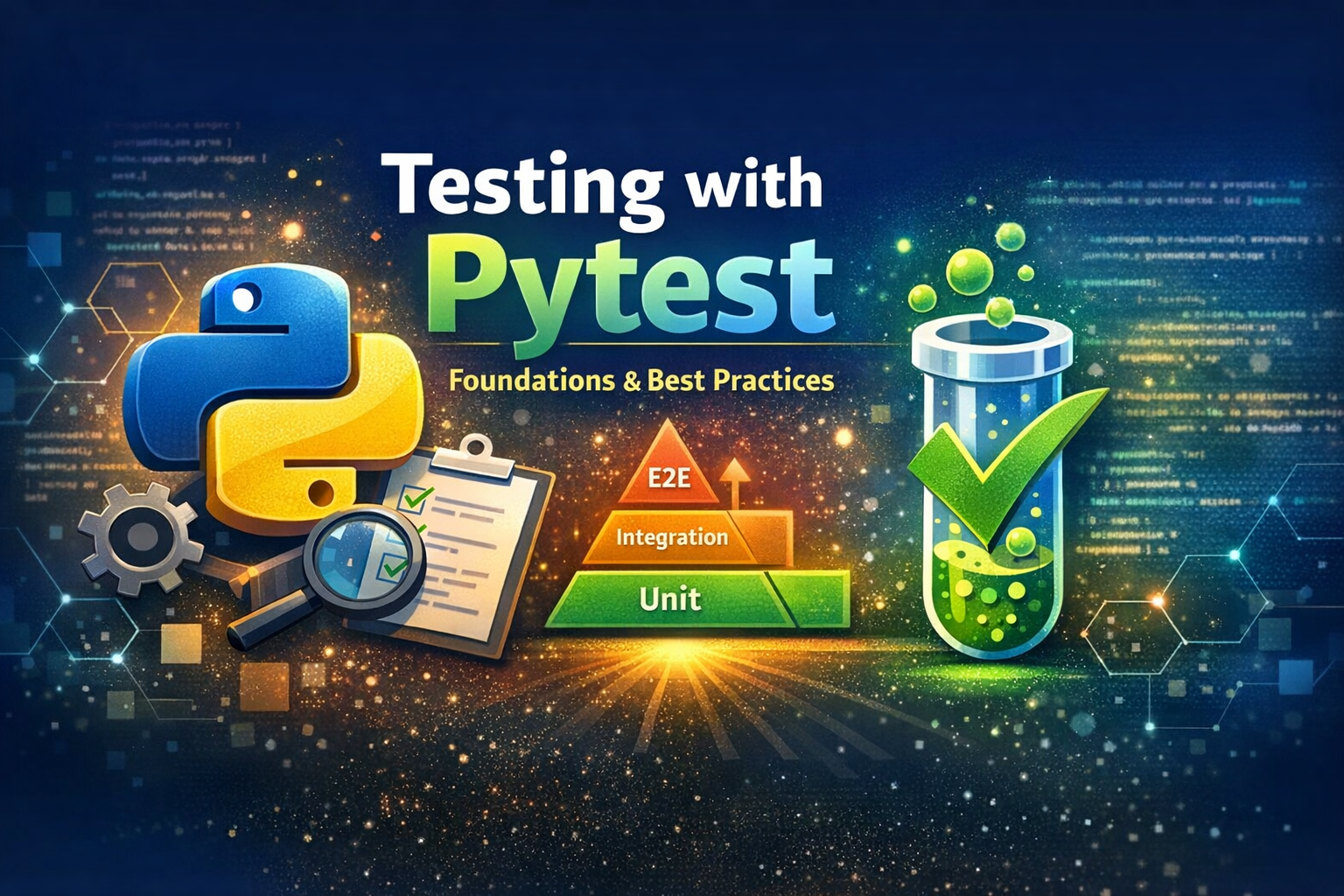
Testing software is not just a technical development step, it’s a quality, confidence, and sustainability strategy. Systems without tests tend to break frequently, create fear of changes, and drastically increase maintenance costs.
In this post, we’ll focus 100% on theory, explaining fundamental concepts of automated testing using Pytest, the most popular testing framework in the Python ecosystem.
👉 In the next post of the series, we’ll apply all of this to a real Flask project consuming the GitHub public API.
What is Pytest?
Pytest is a testing framework for Python that makes it easy to create simple, readable, and scalable tests. It allows testing from isolated functions to complete systems.
Why is Pytest so widely used?
- Simple syntax (based on
assert) - Automatic test discovery
- Powerful fixtures system
- Excellent plugin support
- Scales well for large projects
Compared to unittest, Pytest is more expressive, less verbose, and more productive.
What is the purpose of tests?
Tests exist to reduce uncertainty.
They help to:
- Ensure code works as expected
- Detect errors quickly
- Prevent regressions
- Enable safe refactoring
- Serve as living documentation of the system
Code without tests might work today, but it’s fragile tomorrow.
When to write tests?
- When creating new features
- When fixing bugs (especially regressions)
- Before refactoring existing code
- In business-critical code
And when NOT to write tests?
- Very quick proofs of concept (POCs)
- Completely disposable scripts
Even in these cases, tests can still bring benefits.
Types of Tests
Understanding test types is essential to create a balanced strategy.
Unit Tests
- Test isolated functions or methods
- Don’t access database, network, or file system
- Are fast and cheap
✔️ Foundation of the test pyramid
Integration Tests
- Test communication between components
- Example: application + database, application + external API
✔️ Detect real integration failures ❌ Slower
Functional Tests
- Test complete application flows
- Simulate user behavior
✔️ High confidence ❌ More complex
System / End-to-End (E2E) Tests
- Test the system as a whole
- Include multiple layers
✔️ Simulate real usage ❌ Slow and fragile
Regression Tests
- Ensure fixed bugs don’t come back
- Usually arise after real incidents
✔️ Protect against recurring errors
Performance Tests
- Evaluate response time and resource consumption
- Identify bottlenecks
✔️ Important in critical systems ❌ Should be used with discretion
The Test Pyramid
A good testing strategy follows the pyramid:
- Many unit tests
- Some integration tests
- Few E2E tests
This ensures speed, confidence, and controlled cost.
The AAA Pattern (Arrange, Act, Assert)
AAA is a test organization pattern that dramatically improves readability.
Arrange
Prepare data, mocks, and context.
Act
Execute the action being tested.
Assert
Validate the result.
Benefits
- Clearer tests
- Less ambiguity
- Easier maintenance
Fixtures in Pytest
Fixtures are reusable functions responsible for preparing and cleaning up the test environment.
Why use fixtures?
- Avoid code duplication
- Centralize setup/teardown
- Make tests more readable
Fixture scopes
function: default (runs for each test)module: once per filesession: once per execution
Pytest Marks
Marks allow you to classify and control tests.
parametrize
Allows running the same test with multiple data sets.
Benefits:
- Less code
- More coverage
- More expressive tests
skip
Consciously ignores tests.
When to use:
- Unavailable external dependency
- Disabled functionality
xfail
Marks tests that should fail.
Benefits:
- Documents known bugs
- Doesn’t break the pipeline
slow
Marks slow tests.
Benefits:
- Selective execution
- Quick feedback in daily work
What is Mock?
Mock is a technique used to simulate external dependencies.
When to use mock?
- External APIs
- Database
- Third-party services
When NOT to use?
- To test internal logic
- Excessively (overmocking)
unittest.mock vs pytest-mock
unittest.mock
- Python standard library
- More verbose
- Uses context managers
✔️ Doesn’t depend on plugins ❌ Code harder to read
pytest-mock
- Pytest plugin
- Integration with fixtures
- Cleaner syntax
✔️ More productive ✔️ More readable
Essential Pytest Plugins
pytest-cov
- Measures code coverage
- Helps identify untested areas
⚠️ High coverage ≠ quality code
pytest-mock
- Facilitates mock creation
- Reduces boilerplate
General Best Practices
- Tests should be simple
- One behavior per test
- Clear and descriptive names
- Avoid complex logic in tests
- Tests should be deterministic
Conclusion
Automated tests are not a luxury, they are a professional necessity. Pytest provides the right tools to write clear, scalable, and reliable tests.
In the next post of the series, we’ll apply all these concepts in a real Flask project, consuming the GitHub public API, with unit, integration, functional, and performance tests.
👉 Continue to Testing GitHub APIs with Pytest - Practice